Banks made $3 billion from overdraft fees in just 6 months: Here’s how to avoid paying them
Motley Fool Money reports U.S. banks made $2.96 billion from overdraft fees in the first half of 2026, averaging $35
Press Release Disclaimer: This is a press release distributed through the XPR Media network. It has not been independently verified by our newsroom.


tete_escape // Shutterstock
The average overdraft fee is about $35, according to the Consumer Financial Protection Bureau (CFPB), and U.S. banks collected $2.96 billion in combined overdraft and non-sufficient funds (NSF) fees in just the first six months of 2026, according to a Motley Fool Money analysis of Federal Financial Institutions Examination Council (FFIEC) Call Report data. That covers 512 banks with more than $1 billion in total assets. Smaller banks are not required to report that data, so the true nationwide total is higher.
Several major banks have cut or eliminated their overdraft fees since 2019, providing their checking accounts an extra perk, but overall, banks are still raking in billions from overdraft fees.
Key points
- Overdraft fees cost: The average overdraft fee is $35, with U.S. banks collecting nearly $6 billion annually.
- Big banks dominate: Major banks like JPMorgan Chase and Wells Fargo generate most overdraft fee revenue.
- Disproportionate impact: Lower-income, younger, and underrepresented groups are more likely to pay overdraft fees.
How much banks made on overdraft fees in 2026 and over time
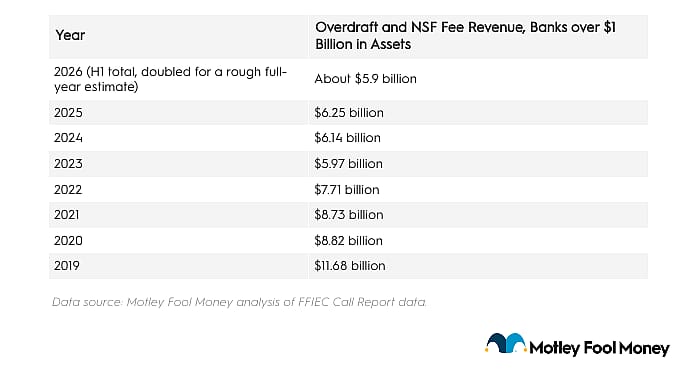
Banks are on pace to generate overdraft fees at about the same level as 2024 and 2025, close to $6 billion, after a roughly $1.7 billion decline from 2022 to 2023.
Motley Fool Money
Revenue from overdraft and NSF fees dropped by nearly half between 2019 and 2023 as several major banks cut or eliminated their fees, with a sharp one-year drop in 2020 as pandemic-era spending patterns and stimulus payments briefly reduced overdrafts.
Overdraft fee and NSF revenue have risen slightly for two straight years since.
One bank accounts for 19% of all overdraft fee revenue
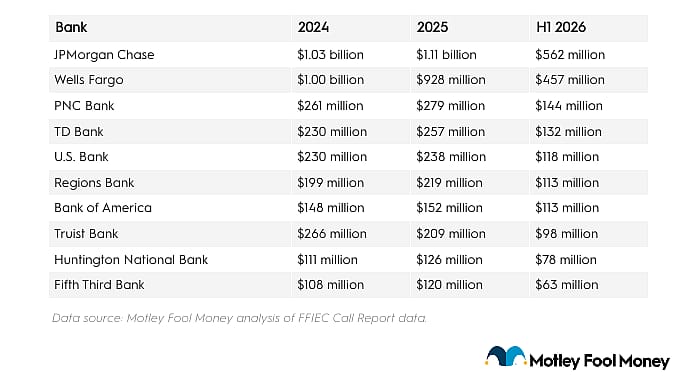
A small number of the largest banks drive most of the industry’s overdraft and NSF revenue.
Motley Fool Money
JPMorgan Chase alone accounted for about 19% of all reported overdraft and NSF fees in the first half of 2026, more than any other bank in the data.
Three banks account for most of the swing in overdraft and NSF revenue since 2019: Chase and Wells Fargo are the two largest collectors in the group, and Bank of America made the deepest overdraft fee and NSF cuts of any bank in the data.
Bank of America’s overdraft and NSF revenue fell from $1.56 billion in 2019 to $140 million in 2023, after the bank lowered its overdraft fee and dropped its NSF fee entirely, and it has edged up only slightly since, to $152 million in 2025.
Chase’s revenue fell from $2.06 billion in 2019 to $1.1 billion in 2023, then recovered to $1.11 billion in 2025 and is on pace for a similar total in 2026.
Wells Fargo’s revenue fell from $1.7 billion in 2019 to $937 million in 2023 and has stayed roughly flat since, at $928 million in 2025, according to Motley Fool Money’s analysis of FFIEC data.
The average overdraft fee is $35, but one major bank charges just $10
The typical overdraft fee is about $35, according to the CFPB. That figure lines up closely with what the largest banks actually charge. For example, JPMorgan Chase charges $34 per overdraft item, capped at three fees per day. Bank of America is the exception at $10 per overdraft, capped at two fees per day, down from $35 before it cut the fee in May 2022, according to the bank.
12% of Americans paid an overdraft fee last year
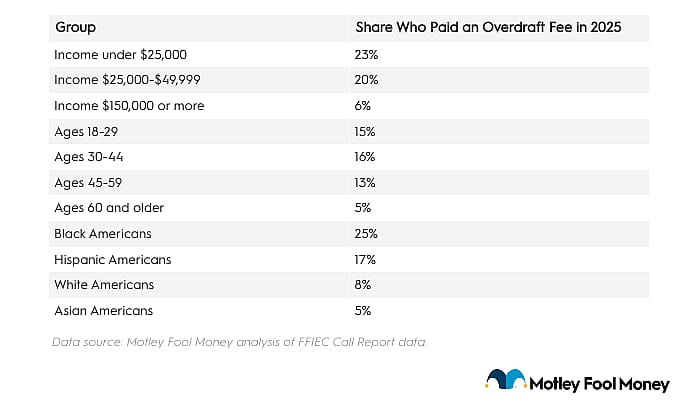
Twelve percent of Americans paid an overdraft fee in 2025, according to the Federal Reserve, but lower-income, younger, and Black and Hispanic Americans were more likely to have paid one.
Motley Fool Money
Those same groups have lower average checking account balances than the groups less likely to overdraft.
How to avoid overdraft fees
The most direct way to avoid an overdraft is to catch a low balance before overspending. Some banks have apps that provide low-balance alerts in real time.
“Set up a low-balance alert and treat that number like it’s your actual zero,” advises Motley Fool Money personal finance expert Joel O’Leary. “A little heads-up text that says ‘hey, you’re getting close’ gives you a chance to react while it’s still a small deal instead of a fee.”
Checking account activity often and keeping a basic budget to provide a running sense of income versus spending can also catch spending that an alert alone might miss. In addition, some checking accounts are no-overdraft-fee accounts, which waive the fee even for accidental overdrafts.
“If you’re overdrafting on the regular, it’s definitely worth switching to a bank with no-overdraft fees,” O’Leary said. “One tradeoff is the best no-overdraft-fee accounts live online, so you’ll need to be comfortable banking mostly from your phone. On the plus side, most online banks have no account fees and great mobile apps, so you usually come out ahead.”
FAQs
What is the average overdraft fee?
The average overdraft fee is about $35, according to the Consumer Financial Protection Bureau. Some of the largest banks charge close to that: JPMorgan Chase charges $34 per overdraft item, while Bank of America charges $10, down from $35 before it cut fees in May 2022.
How much money do banks make from overdraft fees?
U.S. banks with more than $1 billion in assets collected $2.96 billion in combined overdraft and NSF fees in the first half of 2026, according to a Motley Fool Money analysis of FFIEC Call Report data. That is on pace with 2024 and 2025, after revenue fell by nearly half between 2019 and 2023.
Methodology
The bank-level and industry-wide revenue figures in this article come from a Motley Fool Money analysis of FFIEC Call Report data, Schedule RI, item RIADH032, which combines overdraft and non-sufficient funds (NSF) fee revenue on consumer deposit accounts. Only banks with more than $1 billion in total assets are required to report, so the totals in this article do not capture the entire U.S. banking industry; the true nationwide figure is higher.
Full-year figures for 2019 through 2025 use each bank’s year-end (Dec. 31) report, which reflects the full calendar year on a cumulative basis. The 2026 figure uses each bank’s most recent report as of September 2026, which was the second quarter (six-month, January-through-June) report for 507 of the 512 banks and the first quarter (three-month) report for the remaining five. Any full-year 2026 estimate in this article doubles the six-month total and is a rough estimate, not a projection.
This story was produced by Motley Fool Money and reviewed and distributed by Stacker.